Modified Wood for Marine Applications — Salt, Spray, and Submersion Performance
Marina decking, boat building components, LNG carrier support wood, and how modified timber performs in saltwater environments
Marine environments are where modified wood faces its toughest test. Salt spray, constant moisture cycling, occasional submersion, and UV exposure all combine to break down materials that perform fine on land. At Chambroad, marine applications represent one of our most technically demanding product categories — and also one of the most satisfying when a product holds up after three years of saltwater exposure.
Our marine anti-corrosion flooring and LNG cargo tank support wood are engineered specifically for these conditions. Here's what the data says about performance, and what specifiers need to know before specifying modified timber in a marine context.
Reality check: Modified wood is not "marine-grade stainless steel" of the timber world. It has limits. We're upfront about those limits because overselling leads to failed projects, which hurts everyone in the supply chain.
What "Marine Grade" Actually Means for Modified Wood
There's no single international standard that defines "marine grade" for modified wood (unlike marine plywood, which has BS 1088 or similar). In practice, marine suitability means:
- Decay resistance equivalent to durability class 3+ per EN 350
- Salt spray resistance (no surface degradation after 1000h ASTM B117)
- Dimensional stability under high-humidity cycling (≤2% width change at 85% RH)
- Fastener compatibility with stainless steel / hot-dip galvanized hardware
- Low leaching rate (important for waterway regulations)
Our marine-grade products meet or exceed all five criteria above. But here's the nuance: different marine applications have very different performance requirements. A dock deck faces different conditions than a boat interior panel.
Marine Application Categories — What Works Where
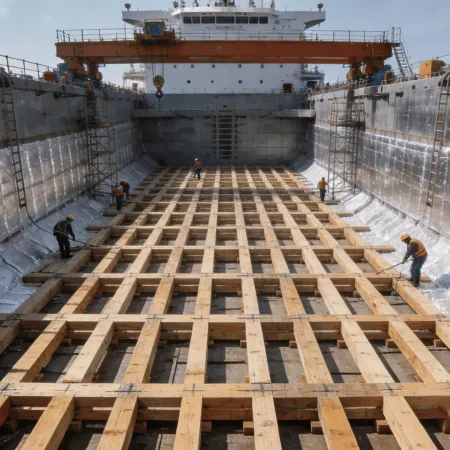
The LNG Support Wood Story — Our Most Specialized Marine Product
This one deserves special attention because it's genuinely unusual. Our LNG carrier support wood is used as insulation-bearing supports inside liquid cargo tanks on LNG carriers. The temperature is -163°C. That's cold enough to make most materials shatter like glass.
Here's why modified wood works where many alternatives fail:
Why Modified Wood Works at -163°C
- Cellulose structure retains toughness at ultra-low temps
- Low thermal conductivity (insulates the tank from hull)
- Compressible enough to accommodate tank contraction
- Bio-based (meets IMO environmental requirements)
Test Data (Representative)
- Impact strength at -163°C: >40 kJ/m²
- Compression perpendicular: ≥12 MPa at -163°C
- Thermal conductivity: ≤0.13 W/(m·K)
- Moisture absorption at -163°C: essentially zero
This product is specified by major shipyards building LNG carriers. If you're involved in shipbuilding or LNG vessel outfitting and need technical data beyond this summary, contact us directly — we can share detailed test reports under NDA.
Fastener Selection — The Silent Killer of Marine Timber
More marine timber projects fail because of fasteners than because of the wood itself. Galvanic corrosion between carbon steel fasteners and modified wood in a salty environment is aggressive. Here's the rulebook:
- Use only stainless steel (A4/316) or silicon bronze for exposed fasteners. Hot-dip galvanized is OK below the waterline but will corrode in the splash zone within 2–3 years.
- Pre-drill every hole near board ends. Modified wood is denser than untreated pine and can split if you drive screws too close to an edge without pre-drilling.
- Counter-sink properly. Flush-mounted fasteners reduce snag points and prevent water pooling around the screw head — both accelerate corrosion.
- Check torque annually for structural connections. A quick walk-through with a torque wrench takes minutes and prevents connection loosening from vibration and thermal cycling.
Service Life Expectations by Application
| Application | Expected Service Life | Conditioning Factor |
| Marina decking (above waterline) | 18–25 years | Assumes proper drainage, annual cleaning |
| Boardwalk / coastal walkway | 15–22 years | Higher wear = shorter life; depends on traffic volume |
| LNG carrier support (cryogenic) | 25–30 years (vessel design life) | No biological degradation at cryogenic temp |
| Boat interior paneling | 20+ years | Protected environment; main risk = mechanical damage |
*Service lives assume proper installation, appropriate fasteners, and periodic inspection. Actual life varies significantly based on local climate, installation quality, and maintenance practices.
The Bottom Line on Marine Applications
Modified wood isn't magic. It won't survive indefinitely underwater without treatment, and it won't outperform fiberglass composites in every metric. But for marina decking, boardwalks, boat interiors, and specialized applications like LNG support, it delivers a combination of performance, cost-effectiveness, and environmental credibility that alternatives struggle to match.
If your project involves any form of marine timber specification, send us the application details early. Some marine applications require custom testing (like cryogenic impact testing) that adds lead time. Getting started sooner rather than later keeps the project schedule intact.
Specifying Modified Wood for a Marine Project?
From marina decks to LNG carrier components, we provide application-specific test data, sample availability, and technical consultation for all marine-spec modified wood products.
Or contact our technical experts for a free consultation on marine-grade modified wood specifications.