



.png?imageMogr2/crop/220x71/gravity/center/format/webp)

A grade selection framework for impact-critical molded parts — matching flow, toughness, and stiffness to the real-world failure modes your product faces
The fastest way to pick the wrong polypropylene copolymer grade is to treat all impact applications as the same problem. A door panel that survives side-impact testing at 23°C, a pallet that absorbs forklift strikes at -10°C, and an appliance shell that passes drop tests require different balances of melt flow, ethylene content, and stiffness — even though they're all "impact copolymer PP."
This guide breaks grade selection down by the failure mode that matters, not the industry category. Because a bumper fascia failing in cold impact and an industrial container cracking after repeated handling aren't the same problem — and they shouldn't get the same grade.
Start With the Failure Mode, Not the Application Name
Five distinct failure modes drive impact copolymer grade selection in injection molding. Map your product to the right one, and the grade decision narrows from "pick one of four" to "pick the one that solves this specific problem":
| Failure Mode | What It Looks Like | Dominant Material Requirement | Recommended Grades |
|---|---|---|---|
| Cold-temperature brittle fracture | Part cracks at -20°C or below; survives room-temperature testing fine | High ethylene content, optimized EPR domain size distribution | EP548R, SP179 |
| Large-area impact (parking, drop, collision) | Wide-area energy absorption needed; crack propagation is the concern | High stiffness + high impact — difficult combination; wrong grades sacrifice one for the other | LA640T, EP548R |
| Flow-limited thin-wall fill | Complex thin-wall geometry freezes before filling; impact is secondary to moldability | High MFI (25+), good flow-to-impact ratio | K9930H, LA640T |
| Repeated handling fatigue | Cumulative micro-crack accumulation from repeated impact cycles | High toughness + consistent batch-to-batch quality | SP179 |
| Weld-line failure under load | Break at knit line locations where flow fronts meet around cores or multiple gates | Highest bulk impact strength to compensate for 40–60% weld-line knockdown | EP548R, SP179 |
If your part has multiple failure modes — a thin-wall automotive interior panel that faces both flow-limited fill AND cold-impact testing — you may need to compromise on one property to satisfy the dominant constraint. Start with the failure mode that would be most expensive or dangerous if it occurred in the field, and optimize for that.
Grade Deep Dive: What Each Grade Is Engineered For
Chambroad's impact copolymer PP line includes four primary grades. Each targets a specific quadrant of the flow-impact-stiffness triangle. Here's what you need to know about each one — not the datasheet numbers, but what the material does in production:
K9930H — The Thin-Wall Workhorse
High flow, high stiffness, and the low-odor, low-blister performance that automotive interior specifications demand. When the mold has long flow paths and thin sections that freeze quickly, K9930H fills the cavity before the melt front has a chance to stall. The low odor isn't a marketing bullet — it's a compliance requirement for interior parts tested under OEM VOC standards. The low blister tendency means fewer rejects after post-molding heat immersion tests (typically 85°C water, a common automotive quality checkpoint).
Best for: Door panel liners, thin-wall appliance housings, complex parts where you'd rather not use hot-runner systems to compensate for poor flow.
Watch for: The high flow comes at the cost of some impact toughness. If the part sees cold-temperature service, validate low-temperature Izod before locking this grade.
LA640T — Stiffness Without Sacrificing Impact
What distinguishes LA640T is that it delivers both high modulus and high flow in the same grade. Most impact copolymers sacrifice stiffness to get toughness — LA640T doesn't trade off as much. For large exterior panels that need to hold their shape at highway speeds while surviving parking impacts and cold-temperature testing, this grade hits a combination that isn't available from every supplier's portfolio.
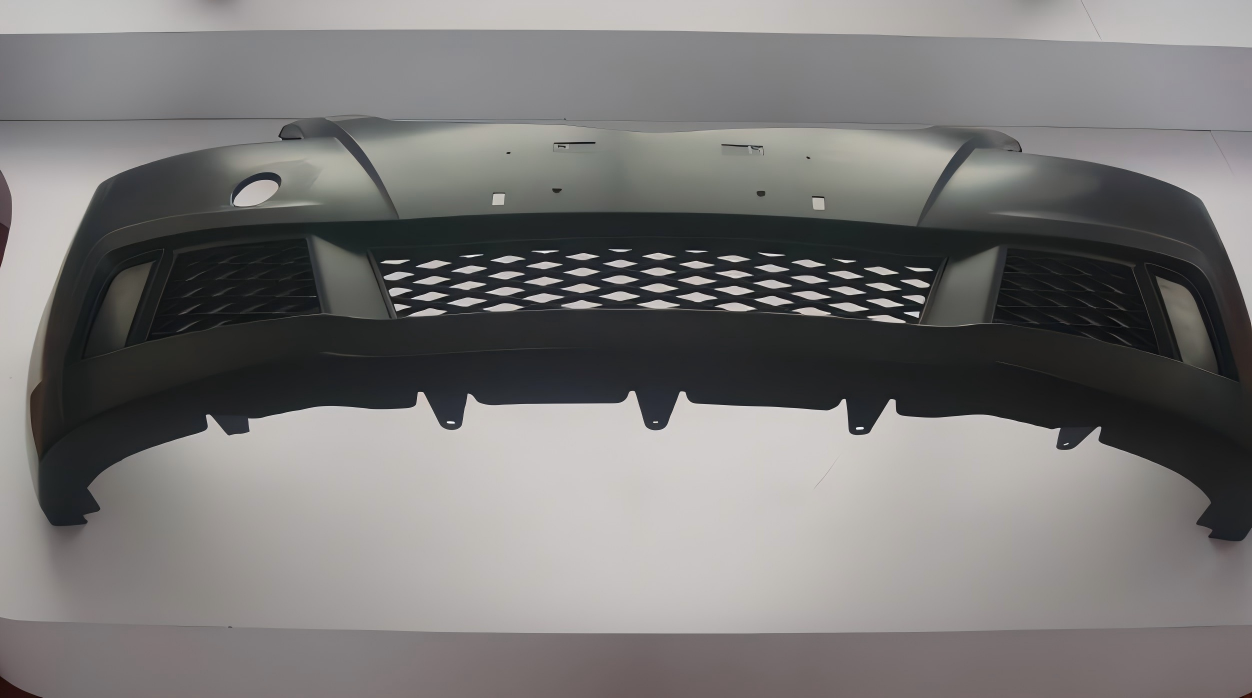
Best for: Bumper fascia, exterior trim panels, headlight bezels — anything where the part is visible, large, and subject to both mechanical and aesthetic requirements.
Watch for: High-modulus copolymer grades can be less forgiving on mold surface finish. If the part has a visible Class-A surface, validate surface appearance on the first trial shots.
EP548R — The Balanced Structural Grade
EP548R sits in the middle of the stiffness-impact-flow triangle, and that's by design. Structural parts — battery support brackets, fender liners, load-bearing interior components — need all three properties simultaneously. This grade's formulation targets low warpage and dimensional stability, which matters when molded parts need to fit precisely into assemblies without post-molding straightening operations.
Best for: Battery brackets, engine undertrays, HVAC housings, and any structural part where the mounting dimensions are critical and distortion means assembly-line rejects.
Watch for: The balanced formulation means it won't excel at any single property — if your application pushes one requirement to an extreme (ultra-high flow, or best-in-class impact), one of the other grades may be a better fit.
SP179 — Industrial Toughness, Production Consistency
SP179 is not designed to achieve extreme property values on a datasheet.It's about making parts that survive the third forklift strike, the tenth stack cycle, and the fifth year in a cold warehouse — and doing it with the same cycle times and rejection rates from batch to batch. For industrial container and pallet molders running high volumes, the batch-to-batch quality consistency is the feature that determines whether a production campaign hits its yield targets.
Best for: Returnable industrial packaging, crates, pallets, heavy-duty material handling containers where impact during handling is the dominant failure mode.
Watch for: SP179 prioritizes toughness over stiffness — if the part needs to resist deflection under stacking loads, check the flexural modulus against your design requirement and consider wall thickness adjustments.
Cold-Weather Impact: The Test That Separates Real Copolymer Performance
Room-temperature notched Izod tells you how the material behaves in a lab at 23°C. Cold-temperature impact tells you whether the part survives a Canadian winter, a northern European cold snap, or an unheated distribution warehouse in January. The gap between these two numbers is where grade selection actually happens.
Homopolymer PP undergoes a ductile-to-brittle transition at roughly 0°C. Below that temperature, it stops absorbing impact energy and starts cracking. Impact copolymer PP pushes that transition temperature down to roughly -15 to -25°C, depending on ethylene content and domain morphology. The reason: the ethylene-propylene rubber phase stays flexible at temperatures where the polypropylene matrix has already stiffened. The EPR domains remain capable of absorbing and dissipating crack energy even after the PP phase loses its ductility.
Here's a practical way to think about it for grade selection:
- Part never sees sub-zero temperatures — K9930H or LA640T are fine; no need to chase extreme cold-impact numbers.
- Part may see temperatures down to -10°C — Verify the grade's cold Izod; EP548R typically handles this range.
- Part will see temperatures down to -20°C or lower — EP548R or SP179; request actual cold-temperature test data from the supplier, not just a generic range.
- Part faces impact AT low temperatures (cold drop test, cold parking impact) — This is the hardest case. Impact energy absorption at -20°C can be 30–60% lower than at 23°C even for copolymer grades. Test with the actual part geometry, not just a notched specimen.
Low-temperature impact testing — what to ask for
Notched Izod at 23°C is standard on every PP datasheet. If your application involves cold service, ask the supplier for these three datasets: (1) notched Izod at -20°C and -30°C, (2) instrumented puncture impact (multiaxial) at the same temperatures — this better represents real-world part impact than notched Izod does, and (3) cold impact data after thermal aging, because the EPR phase can degrade with repeated high-temperature exposure during processing, affecting subsequent cold performance.
The Weld-Line Problem: Why It's Worse With Impact Copolymer Than You'd Think
Here's something datasheets don't tell you: impact copolymer PP's impact strength drops 40–60% at weld-line locations. The bulk material might test at 50 kJ/m² notched Izod, but test that same grade at a knit line and you might see 20–25 kJ/m². The EPR domains that provide impact resistance don't knit back together when two flow fronts meet — the rubber phase at the weld line is discontinuous, and the crack has a clear path through.
This matters for grade selection because the right strategy changes depending on whether you can eliminate the weld line or have to live with it:
- If you can reposition gates to move the weld line away from stressed areas — any of the four grades will work; select based on flow and stiffness requirements.
- If the weld line is unavoidable and sits in a high-impact zone — step up to a higher-toughness grade (EP548R or SP179) to compensate for the weld-line knockdown. A part molded in SP179 with a 50% weld-line knockdown may still outperform a part molded in K9930H with no weld line at all.
- If both the weld line is unavoidable AND cold impact is a requirement — this is the intersection of two knockdown factors. Test actual molded parts (not test specimens) at the minimum service temperature. Don't rely on standard notched Izod to predict this performance.
Processing Parameters That Affect Impact Performance
Impact copolymer PP processes differently from homopolymer — not just in recommended temperature settings, but in how processing choices affect the final part's impact performance. Get these parameters wrong and you can take a well-chosen grade and mold it into a brittle part:
| Parameter | Recommended Range | Impact of Getting It Wrong |
|---|---|---|
| Melt temperature | 200–250°C (stay under 250°C) | Above 260°C: EPR phase degrades → discoloration + reduced impact. Below 200°C: poor melt homogeneity → inconsistent impact distribution across the part |
| Mold temperature | 20–50°C | Lower mold temp (20°C) → amorphous skin layer → better surface impact, more flow marks. Higher mold temp (50°C) → more crystalline surface → better scratch resistance, slightly lower impact |
| Injection speed | Moderate | Very fast fill → EPR domains align in flow direction → anisotropic impact (tougher perpendicular to flow, weaker parallel). For multi-directional impact (pallets, containers), moderate speed = more isotropic |
| Residence time | Under 5 minutes at melt temperature | Extended residence → progressive EPR degradation → each shot gets progressively more brittle. If the line stops, purge after 5–8 minutes |
| Back pressure | 0.5–2 MPa | Too low → poor EPR dispersion → inconsistent impact. Too high → excessive shear heating → same EPR degradation risk as elevated melt temperature |
| Regrind content | 15–20% max for critical impact applications | Each regrind pass degrades EPR slightly. Above 30% regrind, cold impact can drop measurably. Track notched Izod on molded specimens per production batch |
Real Scenarios: Grade Decisions Under Constraint
Grade selection theory is clean. The real world adds constraints — existing molds, regulatory requirements, supply chain preferences. Here's how the grade decision shifts when practical constraints enter the picture:
Scenario 1: Thin-wall appliance housing, 1.2mm nominal wall
Constraint: Existing 2-plate cold-runner mold; can't add hot runners. Part must survive 1.5m drop test.
Decision logic: Flow is the gate — if the cavity doesn't fill, nothing else matters. Start with K9930H for flow and verify that its impact toughness clears the drop-test requirement. If it doesn't, LA640T gives you comparable flow with higher stiffness, but check the thin-wall fill behavior at your actual mold temperature.
Likely pick: K9930H.
Scenario 2: Automotive battery bracket, engine bay location
Constraint: Part carries 15 kg static load, sees 90°C ambient, must survive crash pulse without fracturing. Multiple gate knit lines in stressed areas.
Decision logic: This is both a stiffness and an impact problem. The elevated temperature rules out grades with marginal HDT. The weld lines mean you need higher bulk toughness as a buffer. EP548R's balanced formulation plus low-warp characteristic addresses the load, temperature, and dimensional requirements. Verify HDT at 0.45 MPa against the 90°C ambient before finalizing.
Likely pick: EP548R.
Scenario 3: Industrial tote, outdoor warehouse storage in northern climate
Constraint: Faces forklift impact and stacking loads at -20°C warehouse temperatures. High-volume production — cycle time consistency matters.
Decision logic: Cold impact is the hard constraint. SP179 targets this exact use case — toughness-first formulation with production consistency. The stacking load concern can be addressed through wall thickness and rib design rather than trying to get stiffness from a higher-modulus grade that would sacrifice cold impact. Confirm cold Izod at -20°C on molded specimens.
Likely pick: SP179.
Scenario 4: Bumper fascia, Class-A visible surface
Constraint: Large part area (1.2m²), visible surface, must pass 4 km/h pendulum impact and cold impact at -20°C.
Decision logic: LA640T's high-modulus-plus-high-flow combination suits the large-area fill and the stiffness requirement to hold shape. For the cold-impact requirement, request specific cold Izod data and consider whether a TPO (thermoplastic olefin) compound — impact copolymer PP modified with additional elastomer — might be necessary if the cold-impact bar is high. LA640T is the starting point; validate or escalate from there.
Likely pick: LA640T, TPO back-up if cold impact fails.
Scenario 5: Switching from homopolymer to copolymer mid-production
Constraint: Existing mold and process; field failure reports of cold cracking at 5°C. Production can't stop for major retooling.
Decision logic: The priority is to solve the cold-cracking problem with minimal process disruption. Copolymer shrinks slightly less than homopolymer (1.2–1.8% vs 1.5–2.0%), so parts will mold slightly larger. For the temperature range (above 0°C), K9930H provides the impact upgrade without requiring major process changes. Reduce melt temperature by 10–15°C from the homopolymer setting, run trial shots, and measure critical dimensions before committing to production volumes.
Likely pick: K9930H as the low-disruption upgrade.
Dual-sourcing consideration
If your production runs across multiple molding sites or if supply continuity is a concern, consider qualifying two grades that target the same application quadrant. For instance, EP548R and SP179 both address cold-impact structural applications — qualifying both means you have an alternate if one grade faces a supply disruption. The switch between grades will require process adjustment, but less than a switch to an entirely different chemistry.
Regulatory & Compliance Checklist
Grade selection isn't just about mechanical properties. Regulatory requirements can eliminate certain grades from consideration regardless of how well they perform in testing:
- Automotive interiors: OEM-specific VOC and odor limits. K9930H is formulated for low-VOC/low-odor and meets the common automotive interior specifications. Confirm the specific OEM standard your program requires.
- Food contact: All four Chambroad copolymer grades can meet FDA 21 CFR 177.1520 and EU 10/2011. Confirm that the specific production lot carries the required certification documentation.
- REACH and RoHS: All grades are supplied REACH-compliant and RoHS-compliant. Request the compliance certificate for your import documentation.
- UL recognition: If the part requires a UL yellow card (UL 746B), confirm that the specific grade carries UL recognition and that the recognition covers the thickness and color range your part requires.
Chambroad's impact copolymer PP grades — K9930H, LA640T, EP548R, and SP179 — are manufactured under Chambroad Polyolefin quality systems with full traceability from polymerization to pallet. Our technical team provides grade-specific datasheets, mold flow simulation support, and trial material for qualification. Contact us to discuss your specific impact requirements and failure modes.