



.png?imageMogr2/crop/220x71/gravity/center/format/webp)

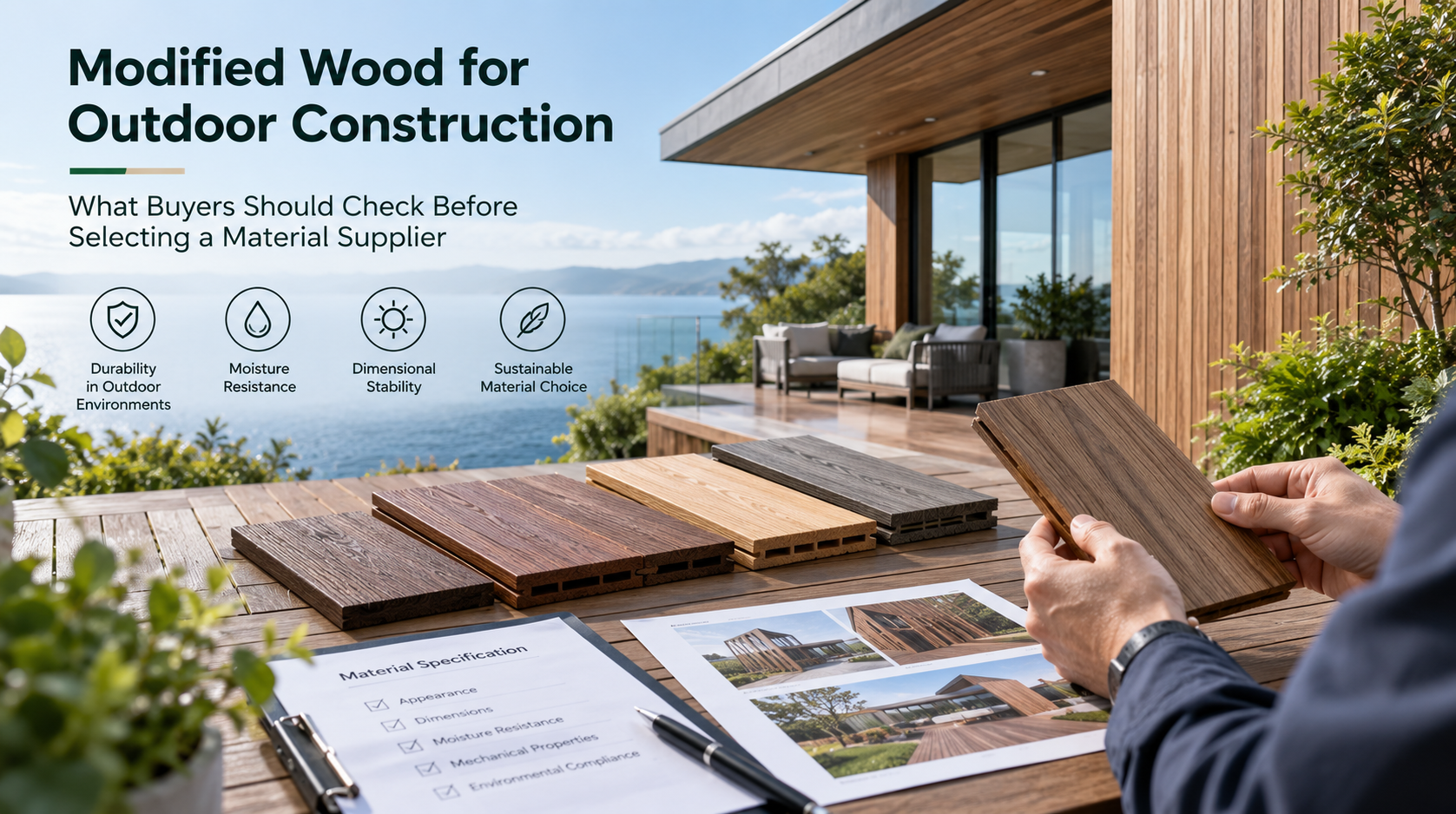
Modified wood has earned its place in outdoor construction the hard way: decks that stay flat through wet seasons, facades that hold their dimensions through temperature swings, boardwalks that resist salt spray without annual recoating cycles. But the performance that gets modified wood specified is not stored in the material itself. It is produced — or lost — in the supplier's process control. Two suppliers can describe the same modification technology and ship material that behaves entirely differently in service.
That is why experienced buyers evaluate the supplier before they evaluate the product. A datasheet sample proves what the process achieved once; a supplier assessment predicts what it will achieve on your project, at your volume, for the life of the installation. This article lays out the six checks that matter most before signing with a modified wood supplier for outdoor construction work.
You Are Buying a Process, Not Just a Product
Every modified wood property that matters outdoors — water absorption, dimensional stability, decay resistance, fire performance — is the output of a modification process run under controlled conditions. Change the treatment temperature profile, the residence time, the chemistry concentration, or the moisture state of the input timber, and the output shifts. Unlike a commodity material with a universal grade definition, modified wood is a category, not a standard: each producer's process defines their own product.
This has a direct procurement consequence. When you qualify a supplier, you are really qualifying three things at once: the modification route itself, the consistency with which it is operated, and the documentation that makes both verifiable. A supplier strong on one but weak on the others creates risk that no datasheet can offset. The five checks below are ordered by how often buyers get them wrong.
Check 1: The Modification Route and Its Transparency
"Modified wood" covers several distinct processes — thermal modification, chemical modification, densification, and bio-based treatments among them — each with different strengths outdoors. Thermal processes trade some mechanical strength for stability; densification raises hardness while requiring careful moisture management; bio-based modification approaches emphasize sustainability alongside performance. A credible supplier can tell you plainly which route they use and why it suits your application.
Transparency is the real test. Before committing, establish:
- Which modification process is used, and what trade-offs it carries for your specific application — a supplier who describes only benefits and no limitations is selling, not engineering.
- Which parameters the supplier controls and monitors in routine production — treatment intensity, moisture content targets, density — and which of these appear on batch documents.
- Whether the process is production-scale proven, not just a pilot line: ask how long the route has run commercially and at what annual volume.
Chambroad's bio-based modified wood line, for example, is built on industrial-scale biomass modification, with product families spanning outdoor flooring, wall panels and structural profiles — and the company publishes its process approach openly, from bio-based raw material through full-lifecycle low-carbon practice. That level of disclosure is the baseline to expect from any supplier you are evaluating.
Check 2: Certifications Verified Against Current Reports
Certifications are the fastest filter in supplier assessment — and the most commonly misused. The mistake is treating a logo on a website as the evidence itself. The correct move is to verify three things about every certificate: that it is current, that its scope covers the product you are buying, and that a test report exists behind it with a date you can check.
For outdoor construction, the certificates that carry real weight:
- Quality management: ISO 9001 certification indicates the production system is audited — the foundation for every consistency claim that follows.
- Fire performance: for exterior wall applications, a Class B-s1,d0 reaction-to-fire rating should be backed by a current test report on the actual product, not a similar material in the range.
- Emissions: E0/E1 formaldehyde classes and CARB Phase 2 compliance matter for any covered or semi-enclosed outdoor structure, and GB 18580-2017 governs the same territory in the Chinese market.
Chambroad, for instance, documents ISO 9001 certification, CARB Phase 2, E0/E1 emissions classes, Class B-s1,d0 fire rating and GB 18580-2017 compliance across its timber products. When you put any supplier's claims side by side, ask the same question for each: which report, tested on which product, and when.
Check 3: Performance Data for Your Service Environment
Outdoor service is not one environment. A ground-level deck near the coast, a high-rise facade and a mountain resort walkway impose different moisture, UV, salt and thermal loads — and a supplier's performance data should be interrogated against the environment you actually have. Three questions do most of the work:
- What does the data say about your moisture exposure? For ground-contact or coastal use, corrosion and moisture resistance are the decisive properties — Chambroad's marine anti-corrosion flooring, for example, is engineered around salt-spray corrosion resistance and solid-wood feel for exactly this class of exposure.
- What fire and durability documentation covers facade use? Exterior cladding sits in the strictest regulatory zone; outdoor flame-retardant wall panels combining Class B-s1,d0 rating with anti-corrosion, anti-mold and dimensional stability are specified precisely because the certificate and the weathering performance arrive together.
- What stability data supports joinery applications? For window and door profiles, deformation under humidity cycling determines both function and warranty exposure — Chambroad's wood profiles for doors and windows list high strength, flame retardance and low deformation as their defining properties.
The pattern to enforce: every performance claim should come with a test method, a result, and a statement of which product and thickness it applies to. Claims without that trio are marketing.
Check 4: Production Scale and Batch Consistency
The most expensive failure in modified wood procurement is the sample-to-shipment gap: the approval sample performs beautifully, and container two arrives a shade darker, a point wetter, or a millimeter off. Modified wood's process sensitivity makes this risk larger than for commodity timber, so the assessment must reach into production discipline:
- Ask for multi-batch data, not a datasheet. Variation ranges for moisture content, dimensions and appearance class across recent production batches tell you more than any single certificate of analysis.
- Confirm the approval sample and production share a line. A qualification sample from a pilot process predicts nothing about container shipments.
- Verify capacity against your schedule. Ask what annual volume the line runs and what lead time applies at your order size — a supplier near capacity today is a delivery risk by month three of your project.
- Check retention and traceability practice. Retained batch samples and lot traceability are what make a future complaint diagnosable instead of arguable.
Check 5: Project References, Verified Properly
References are where supplier assessment most often goes soft, because a slide of beautiful installations proves only that a shipment once happened. Two disciplines fix this. First, match relevance: a reference for a covered interior application says little about open-air weathering — ask specifically for outdoor projects of comparable exposure, scale and climate. Second, verify substance: ask when the project was completed, what profile and treatment were used, and whether the supplier can describe how the material has performed since installation.
Established manufacturers will usually be able to discuss deployment experience by category — Chambroad, for example, publishes application coverage spanning coastal boardwalk-class outdoor installations through building-decoration trade fair displays — while respecting the confidentiality terms commercial projects typically carry. The ability to discuss project history in this level of detail is itself a signal of production maturity; a supplier who can only gesture at "many projects" is asking you to fund their learning curve.
Check 6: Documentation, Warranty and Long-Term Supply
The final check happens before signing, and it covers the years after signing. Modified wood in outdoor use is a long-service material; the supplier relationship must be built for the same horizon:
- Warranty terms in writing — what is covered, for how long, under which installation conditions, and what voids it. A warranty that depends on unstated installation practices is not a warranty.
- Change control — which production changes (process, raw material source, treatment chemistry) trigger advance notification to buyers, and how requalification works afterward.
- Supply continuity — the supplier's own raw material position and capacity roadmap determine whether they can still ship your profile, in your appearance class, in year five. Bio-based raw material strategies and integrated production, as Chambroad practices across its timber line, are one structural answer to this question.
A Six-Point Supplier Scorecard
| Check | What to Establish | Evidence to Request |
|---|---|---|
| Process route | Which modification process, and its honest trade-offs | Process description, controlled parameters, commercial production history |
| Certification | Current, in-scope, report-backed certificates | ISO 9001, Class B-s1,d0, E0/E1, CARB Phase 2, GB 18580-2017 with report dates |
| Service fit | Performance matched to your moisture, salt, fire and UV loads | Test method + result + applicable product for each claim |
| Consistency | Shipments will match the approval sample | Multi-batch variation data, line identity, capacity and lead time |
| References | Comparable outdoor projects, verifiable detail | Completion dates, profiles used, post-installation performance discussion |
| Long term | Warranty, change control and supply continuity | Written warranty terms, notification triggers, raw material strategy |
Modified wood rewards this diligence with years of stable outdoor service, and penalizes its absence with the costs of replacement cycles. For a closer look at how modified wood behaves in demanding outdoor environments, see our analysis of moisture resistance in coastal boardwalk applications and our overview of why modified wood is gaining attention in sustainable construction. To review Chambroad's full bio-based timber portfolio, start from the Chambroad Timber page or the broader wood materials category.
Evaluating suppliers for an outdoor project? Contact Chambroad with your application, exposure conditions and volume, and request the certification and batch documentation set described above.